
A funny thing happens when you've been creating things for a long time.
At first, you're desperate not to sound like anybody else but also to blend in.
You worry about originality. You worry about standing out (but not too much!). You worry that somebody will read your work and think, "Oh, she's just copied so-and-so."
Then, if you stick around long enough (I’ve been freelancing since 2015!), a different fear creeps in and you start worrying that somebody else is copying you.
I've been thinking about that a lot this week. Partly because the internet seems to be having one of its recurring conversations about ownership.
There's been uproar in the bookish corners of social media after some twat trademarked the phrase "Hot Girls Read", a phrase many readers (rightly!) feel belongs to a community rather than an individual. It stinks of white privilege and entitlement.
At the same time, LinkedIn has been busy discussing where inspiration ends and copying begins, with various people sharing stories of having their work, ideas or content imitated by others. And some disappointingly bullying behaviours.
It's fascinating to watch but I thought I’d share the stuff that’s coming up for me…
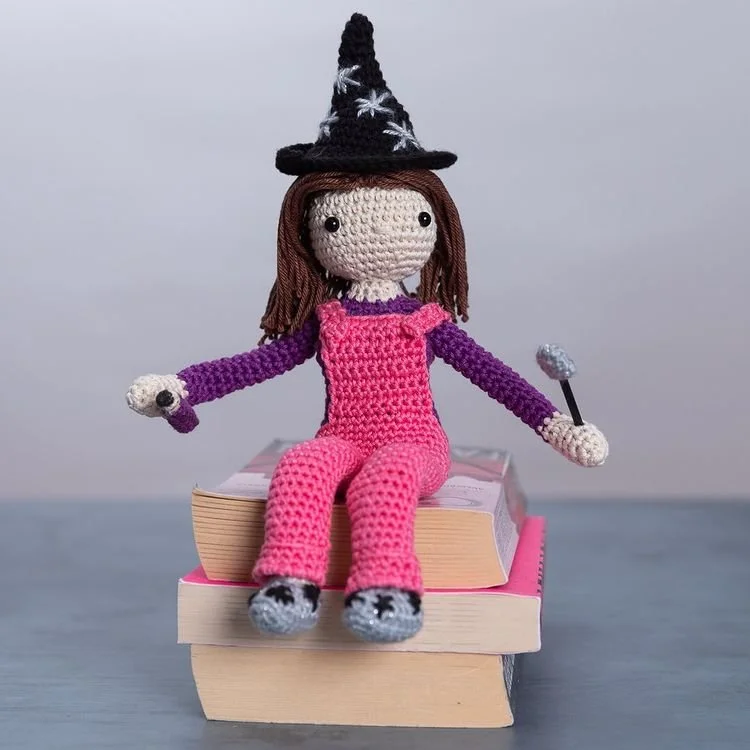
The time someone else started calling herself The Word Witch
I was awake at 4:30am this morning, with all these thoughts swirling round my head and found myself thinking back to a young copywriter copycat who I never confronted.
Back in 2020, I was known online as The Word Witch. It wasn't a title I'd bestowed upon myself, lol. It was a nickname clients had started using and, over time, it stuck. I had lilac branding, playful witchy imagery, and a copywriting business that was doing rather nicely, with workshops, copy coaching, courses...I even commissioned the above crocheted word witch from an amazing crafter!
However, one day early on in lockdown, I discovered another copywriter - a recently furloughed person with limited copy experience, but a dream of online biz life - who appeared to have arrived recently with remarkably similar ideas.
The colours looked verrrryyyy familiar. The vibe was creepily familiar. The nickname looked very familiar. She was bloody calling herself The Word Witch too.
I remember feeling a mix of emotions. Frustration, fo’ sho. A little indignation. So I drafted a message. A perfectly polite message (I wasn’t as cunty as I am now, aged 41 lol). I crafted the sort of message women are very good at writing when we're annoyed. I explained that I'd been using the name for years. I welcomed her to the industry. I gently suggested she might want to consider an alternative.
Then I pressed pause. Took a deep breath and didn't send it. (Pretty sure I had a cathertic cry, actually.)
Instead, I sent screenshots of her stuff to a handful of trusted biz pals and asked what they thought. The consensus was simple: leave it alone. I think I got sent about 5 varying Frozen gifs.
At the time, that felt deeply unsatisfying. I wanted acknowledgement. I wanted her to know. I wanted reassurance that people wouldn't think I was the one doing the copying.
But with the benefit of hindsight, I think my friends were right.
Whilst she could borrow a nickname, as a new copywriter she couldn't borrow my extensive experience. Nor could she couldn't emulate my years in politics, my feminism, my community work, my stories, my values or the magical combination of these things that made my work mine.
The things that mattered most were never the things she could copy in the first place.
Why similar ideas don't mean identical work
A few months later, something similar happened again.
Back at the end of 2018, I'd created a podcast called This Sister Speaks. It was a passion project celebrating women who were supporting other women. I interviewed some incredible guests (Stacey the founder of Black and Beech; the CEO of Women for Women International; and I popped the podcast cherry of Stef Swords-Williams - the founder of F*ck Being Humble!) and I built a small but meaningful platform around it.
Then life happened. I lost a local election, got trolled, was embarking on my Jo Cox Women in Leadership journey, was recovering from pleurisy...and I got depressed…I was juggling my business and being a Councillor, a Governor, Chair of my CLP and Unite the Union branch…I had to let something go.
So the podcast quietly drifted into the background, but the idea never entirely left me.
I knew I wanted to create something around women's confidence and communication. I knew I wanted to help women find the courage to speak up. The seeds of what would eventually become This Sister Speaks as a programme were already there, even if I hadn't fully worked out what shape it would take.
Then, in 2020, I watched somebody else launch something that looked, from a distance at least, surprisingly similar. The colours felt familiar. The language felt familiar. The territory felt familiar. And she was thriving with excellent PR support and a husband who she’d “retired”. She came and did a basic-bitch “confidence” workshop in the mastermind I was in at the time. IMHO, it was not good.
I found myself comparing myslef to her, despite this knowledge AND her bad fringe (IYKYK). My coach at the time gave me a virtual shake and said something along the lines of: “You are more ethical, stronger in your values and your feminism. You would NEVER have accepted an OBE, FFS! You have NOTHING to prove.”
Again, I had a choice. I could spend my energy defending ownership over an idea, or I could spend my energy building something that was ALL ME. Something bolder and better. In the end, I chose the latter.
Not because it didn't sting, because it really did. Seeing people sharing her stuff who had NO IDEA of some of the awful shenanigans she’d been up to in the background of her business really hurt. Not because I enjoyed watching somebody occupy a space I had once imagined for myself. I didn't. And I couldn’t keep up her pace because 2021 was AWFUL for me life-wise (Covid multiple times and the aftermath; miscarriage; finances a mess).
But I knew deep down that I would be okay because even when two people appear to be talking about the same thing, they are rarely bringing the same perspective to it.
Confidence, for example, is not a single conversation. One person's understanding of confidence is shaped by their upbringing, their culture, their politics, their privileges, their setbacks and their experiences. The same is true of leadership, storytelling, communication, creativity and almost every other topic that fills our feeds and bookshelves.
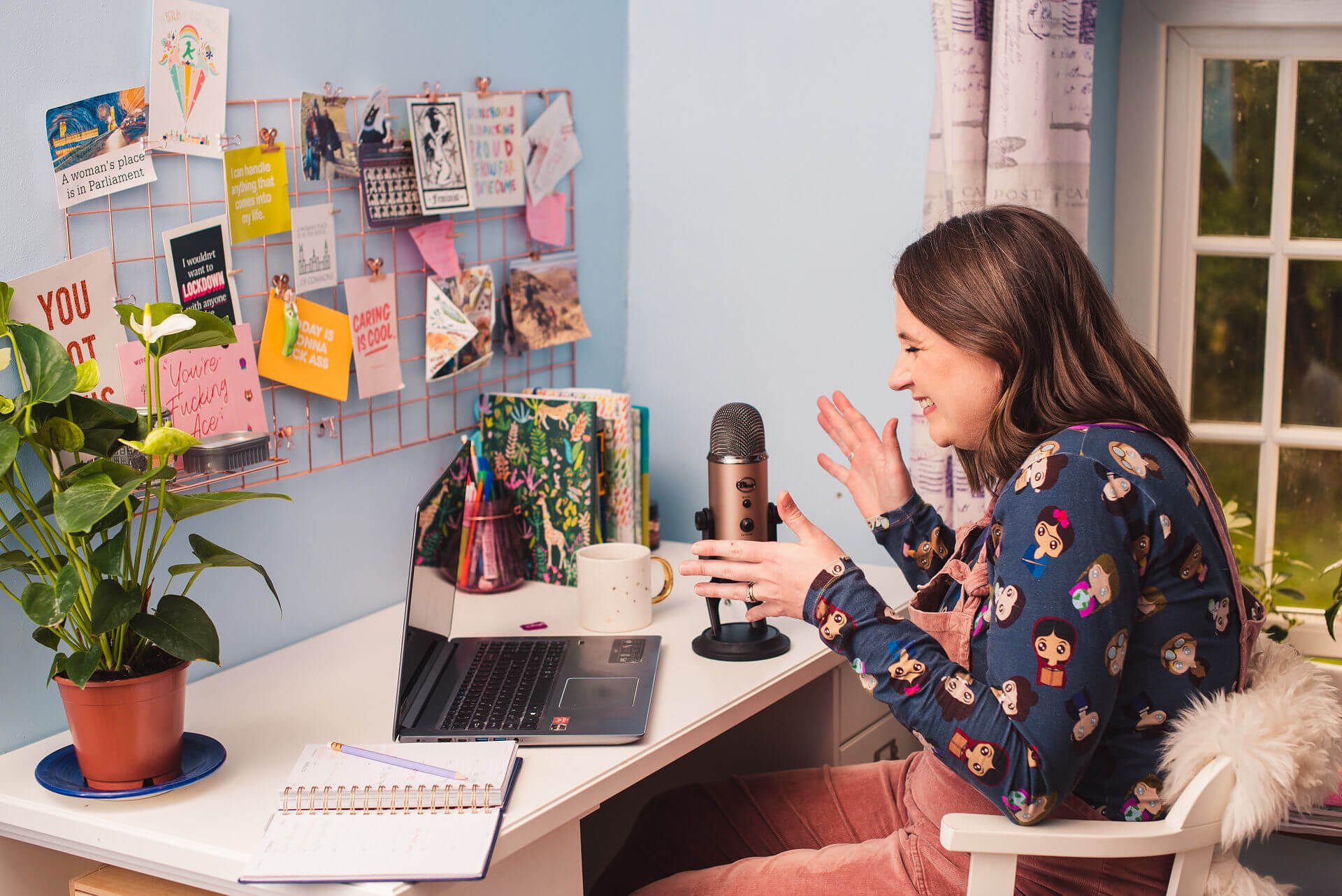
Can anyone really own an idea?
The older I get, the more suspicious I become of the idea that any one person can truly own a conversation.
Women's confidence is not an original idea. Storytelling is not an original idea. Leadership is not an original idea. Community is not an original idea. These are subjects that have been discussed, debated and developed by countless people over many years. Most of the things I care about have long histories and rich traditions behind them.
What matters is not whether you're the first person to talk about something.
In most cases, you won't be. What matters is the perspective you bring, the questions you ask and the experiences that inform your work.
What the "Hot Girls Read" trademark debate reveals
Perhaps that's why the "Hot Girls Read" conversation has struck such a nerve.
The legal arguments are interesting enough, but I suspect the emotional reaction runs deeper than that. For many people, the phrase feels communal. It emerged from a culture of readers sharing recommendations, celebrating books and encouraging one another to read more. When something like that becomes privately owned, it can feel as though a collective idea has been lifted out of the community that created it.
Whether that's fair or not is probably a question for lawyers, of which I ain’t one (as much as I like to think I know everything haha). What interests me more is why so many people reacted so strongly to it.
I think it's because most of us understand, instinctively, that ideas rarely emerge in isolation. They’re shaped by conversations, communities and cultural moments. They evolve because people build on one another's thinking. The books that influence us were influenced by other books. The movements that inspire us were built by countless individuals contributing their voices over time. Same with the music we listen to.
Most of the ideas that have changed my life didn't belong to one person. They belonged to communities of people wrestling with similar questions, sharing insights and gradually moving a conversation forward.
The difference between inspiration and copying
Of course, there will always be people who deliberately copy others. Sometimes it's embarrassingly clumsy or cruelly vindictive.
But I suspect that, more often than not, something less sinister is happening.
People are responding to the same cultural moment. They're noticing the same problems. They're asking similar questions and arriving at ideas that overlap because they're drawing from the same world around them.
That's particularly true in the work many of us do online.
If you're passionate about social justice, women's confidence, communication, leadership or creativity, you're inevitably going to encounter other people exploring similar territory. The existence of their work doesn't diminish yours. If anything, it often reinforces the fact that the conversation matters.
Your voice is the one thing nobody can copy
After all, if somebody can take your colours, your tagline, your content pillars or even your programme idea and leave you with nothing, then perhaps those things weren't the real value in the first place.
The real value has never been a colour palette, a catchy phrase or a clever concept. It's the person behind them. It's the lived experience, the perspective, the relationships, the credibility and the voice that bring those things to life.
Those are the parts that can't be replicated, no matter how closely somebody tries to follow your lead.
And perhaps that's the lesson I wish I'd understood sooner. The longer you spend creating, the less energy you have for guarding every corner of your work and the more confidence you develop in what is uniquely yours. Eventually, you realise that somebody else can borrow the surface-level details, but they can't borrow the substance.
Nobody else gets to do that part.
P.S. Want to grow your courage to stand up for what you believe in and figure out boundaries…? Doors are open for This Sister Speaks (we start June 15th)